Standard
General tour
Both camps
- LengthThree and a half hours
- BirkenauRamp, barracks, ruins
- StartsAuschwitz I
Choose your stop
Auschwitz-Birkenau and the salt mine, guided from Krakow
★ 4.7 · 9,949 ratings
Answer in brief
An Auschwitz and Birkenau tour from Krakow visits both parts of the former camp with a licensed educator: the blocks and exhibitions at Auschwitz I, then the ramp, the barracks and the ruins at Birkenau.
What you see
Check out 23 stops
Choose a route, then tap a pin or stop for its note and a Google Maps link.
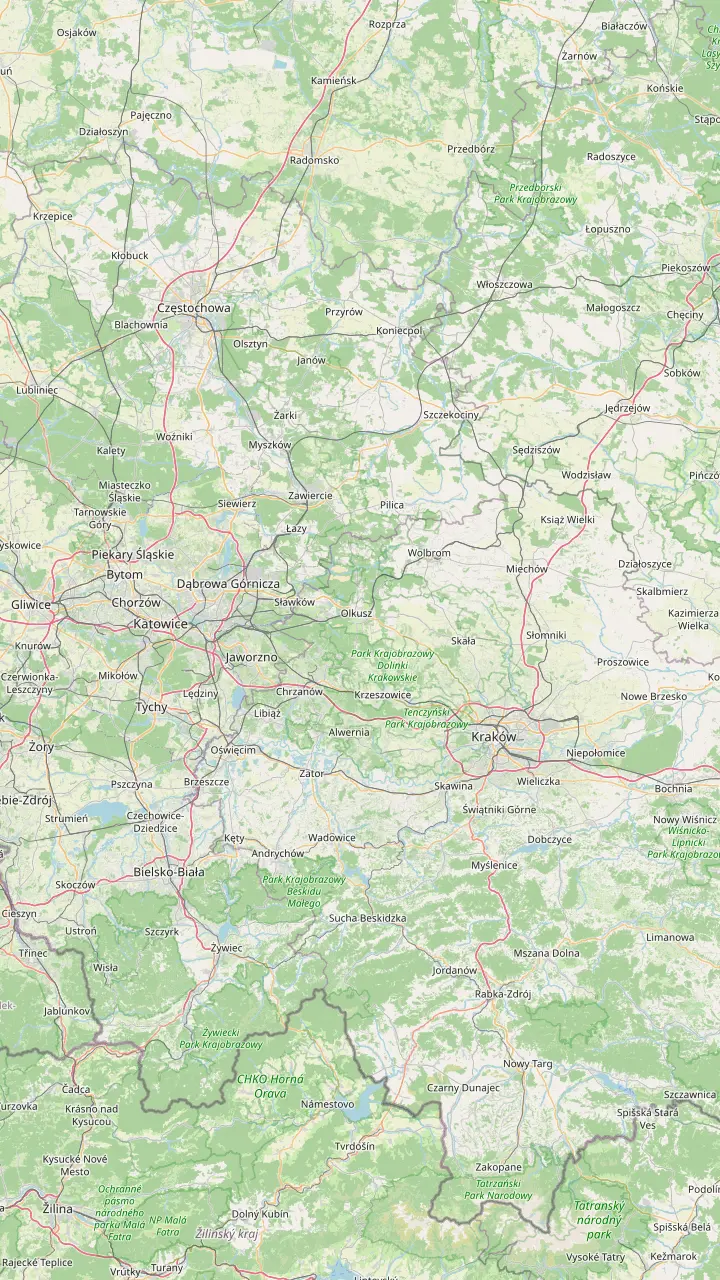
Kraków's Old Town; the main railway station, with the bus terminal joined to it, is a 10-minute walk from the Main Market Square.
Google MapsKraków-Balice airport lies several kilometres west of the city centre; an airport train reaches Kraków Główny in about 20 minutes.
Google MapsKatowice-Pyrzowice airport, approximately 110 km west of Kraków and within about 50 kilometres of Oświęcim.
Google MapsThe Visitor Service Centre and car park at Więźniów Oświęcimia 55, where every visit begins at the former Auschwitz I.
Google MapsThe salt mine in Wieliczka, 10 km south-east of Kraków city centre.
Google Maps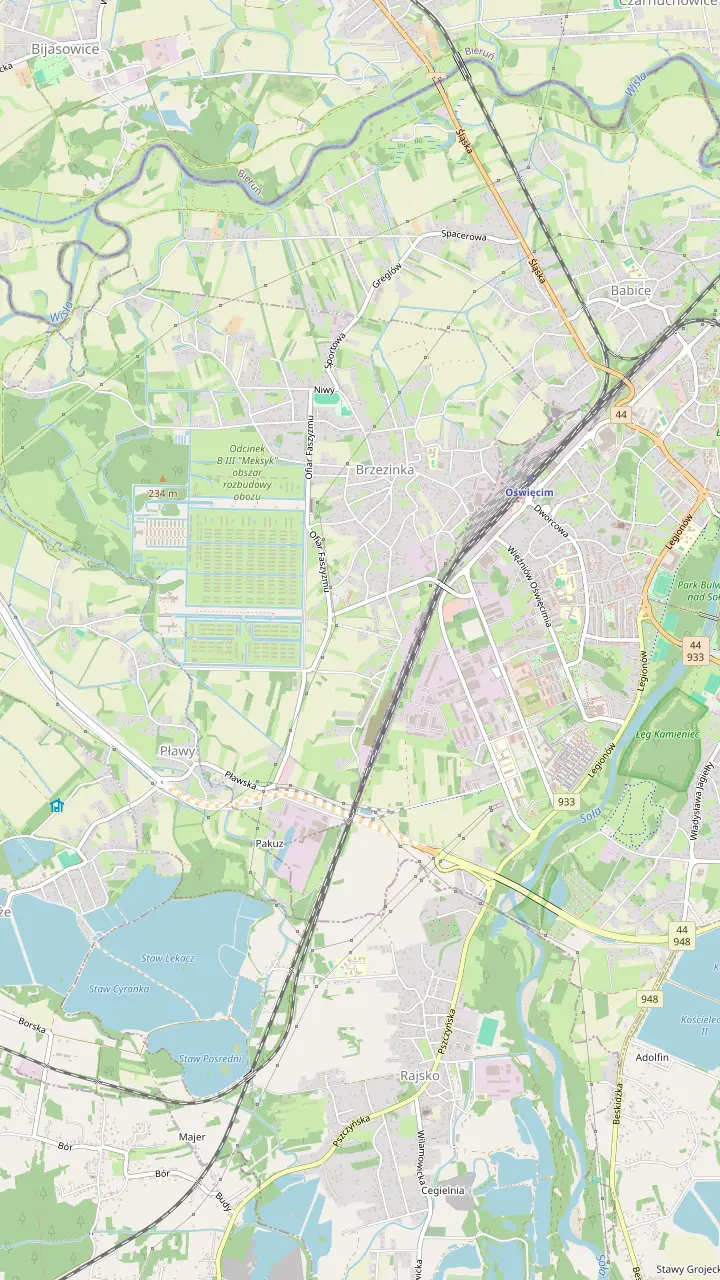
Oświęcim railway station; the Museum's getting-there page puts it approximately 1,500 metres from the Memorial, its visiting page about 2 km.
Google MapsEntry for both parts of the Memorial: arrive at least 30 minutes before your tour for the security check.
Google MapsThe Execution Wall in the courtyard of Block 11, one of the 2 places where candles may be lit; the courtyard is a silence zone.
Google MapsThe Alte Judenrampe, on the walking route between the camps, where trains with deportees stopped and the SS made selections.
Google MapsThe Death Gate building at Birkenau, entered from ul. Ofiar Faszyzmu 12 through a ground-level passage.
Google MapsThe International Monument, unveiled in 1967; candles may be lit here.
Google MapsThe Sauna building at Birkenau; the Memorial warns that the historic roads there are uneven.
Google Maps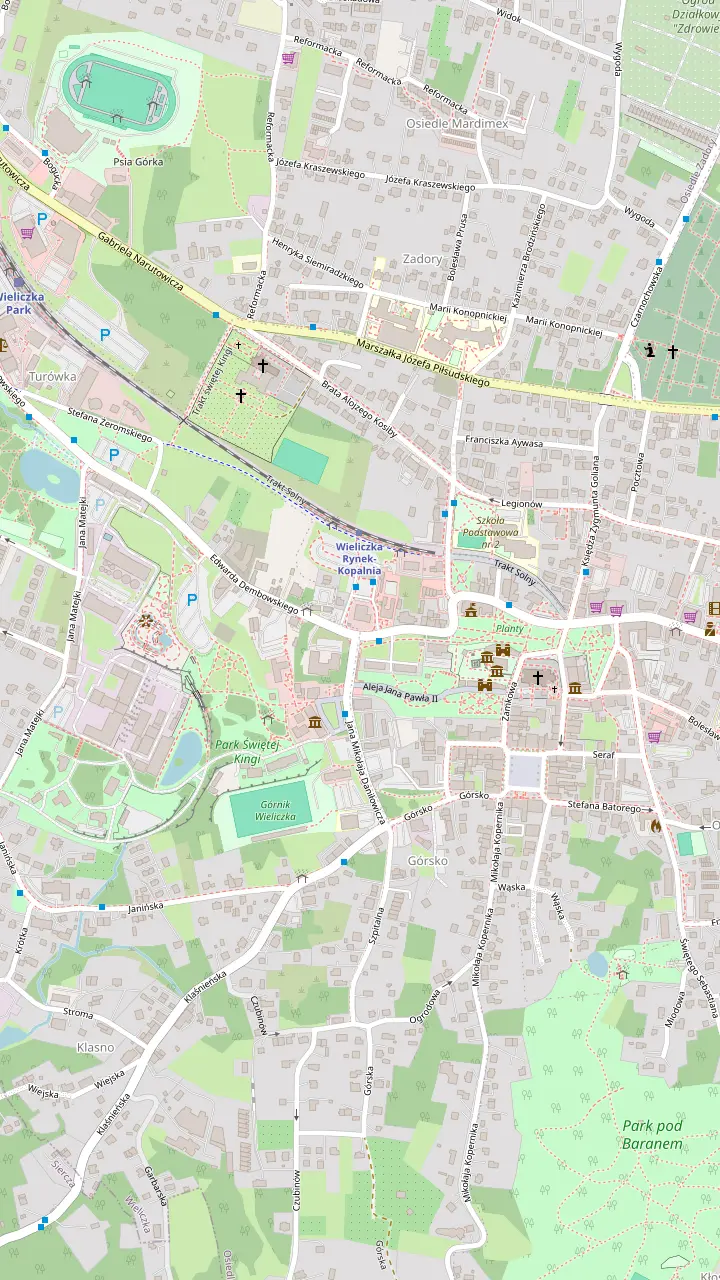
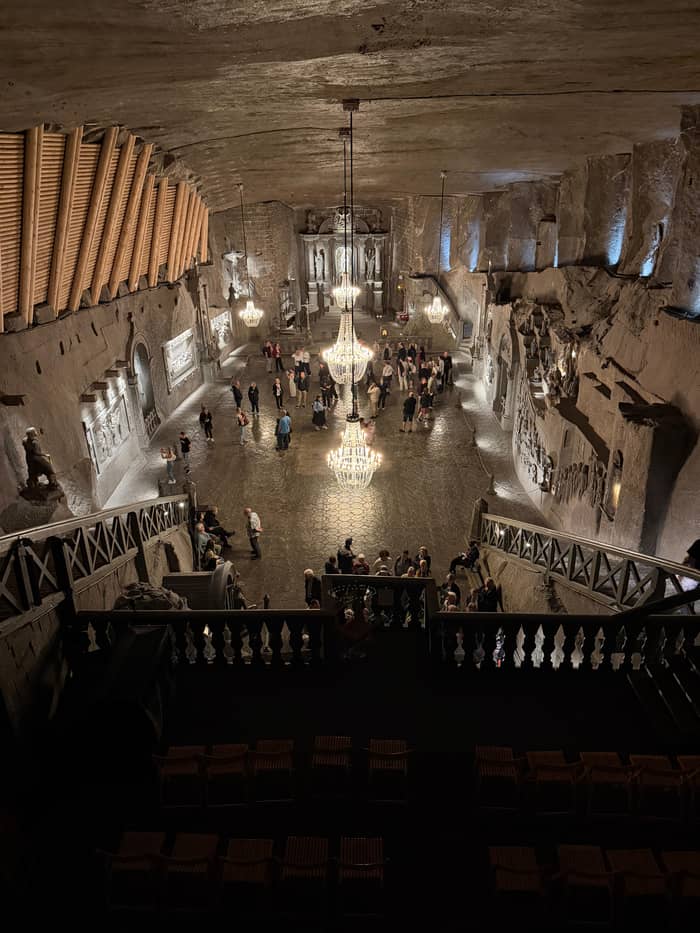
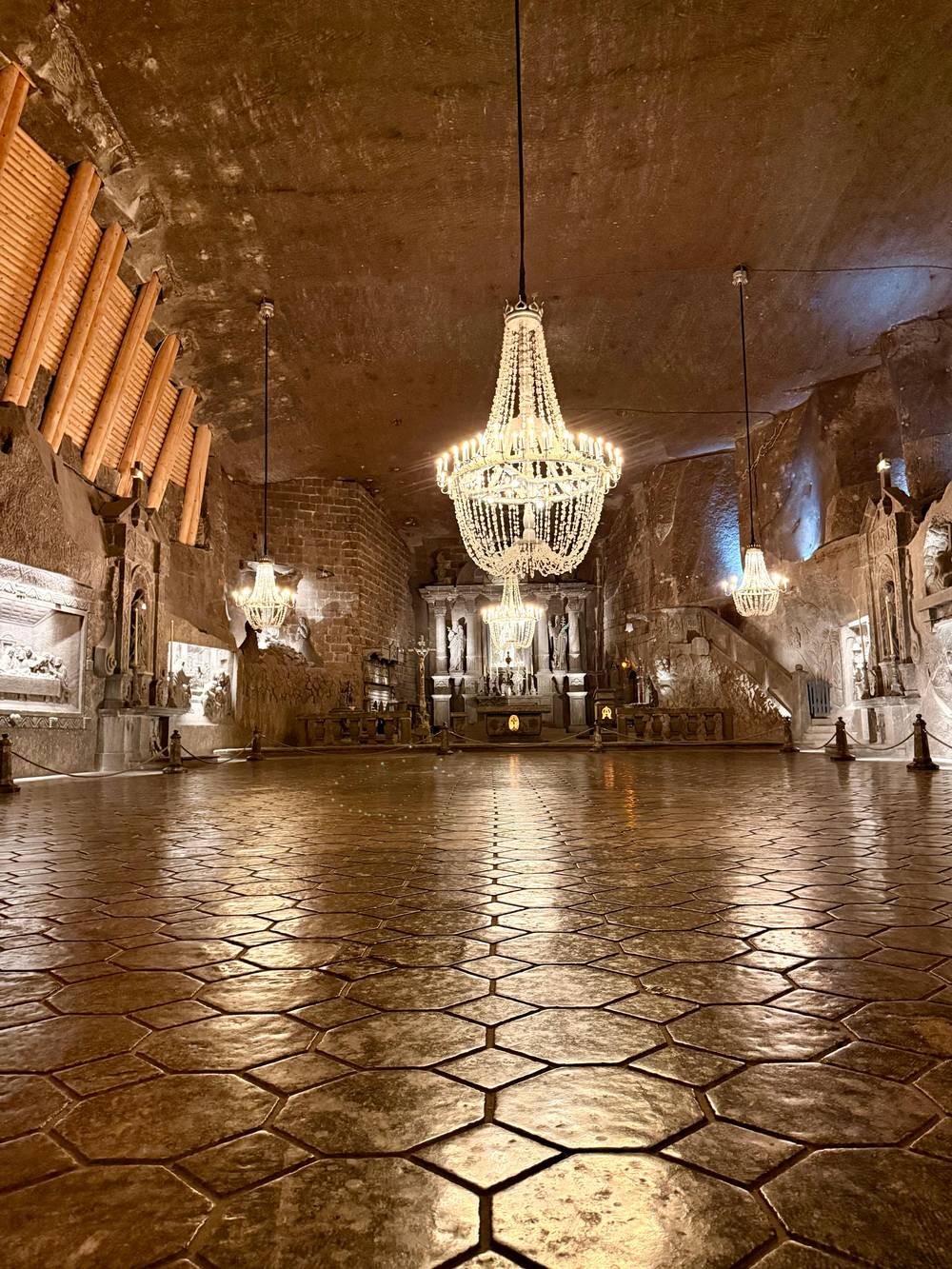
The Daniłowicz Shaft at Daniłowicza 10, where the Tourist Route gathers; it runs between 09:00 am and 05:00 pm.
Google MapsThe Regis Shaft at pl. Kościuszki 9, start of the Miners' Route for visitors over 10.
Google MapsThe suburban train stop a few minutes' walk from the mine, served from Kraków Główny.
Google MapsThe Graduation Tower in St Kinga's Park, next to the biggest car park.
Google MapsCar Park 1 Tężnia, the biggest, entered from Dembowskiego 22.
Google MapsCar Park 2 Daniłowicz next to the shaft building, entered from Daniłowicza 10.
Google Maps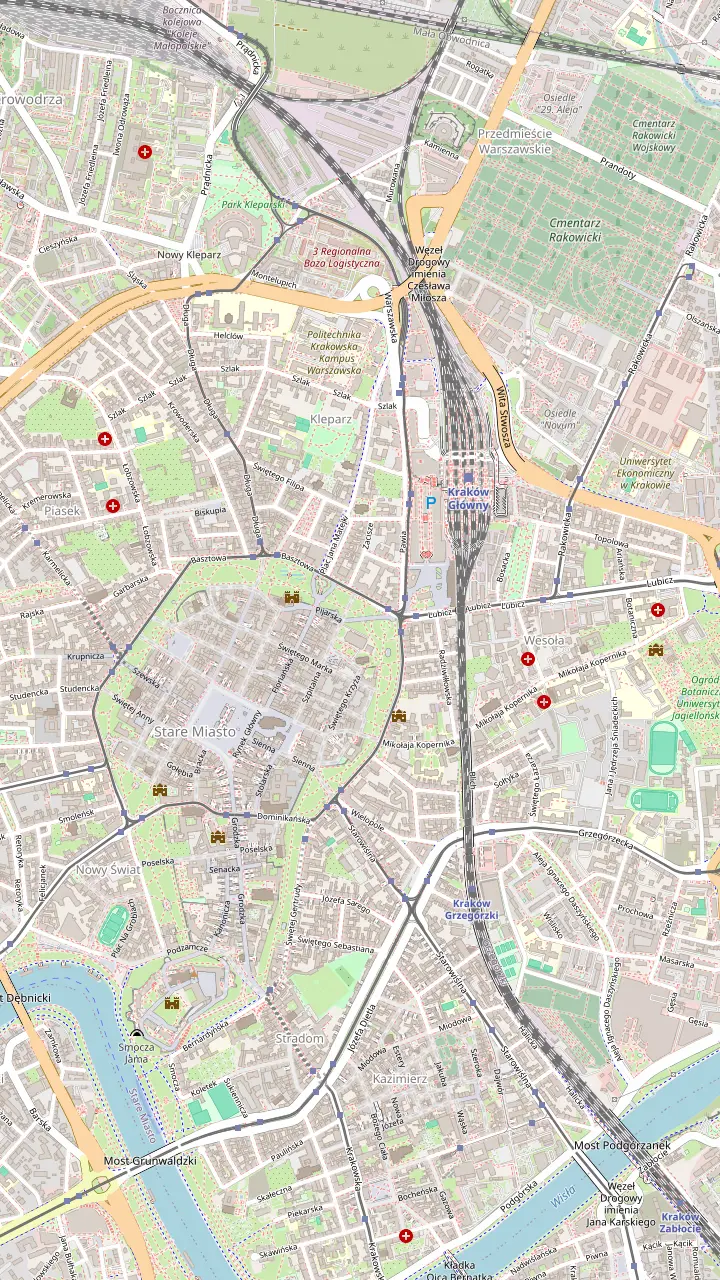
The Main Market Square at the heart of the Old Town.
Google MapsBus 304 to Wieliczka leaves from this stop near Galeria Krakowska.
Google MapsWielopole 2, one of the drop-off points named by the site tour.
Google MapsKraków Główny: regional trains to Oświęcim and Wieliczka, ticket offices 7:00am to 9:00pm.
Google MapsThe bus station at Bosacka 18, joined to the main railway station; Lajkonik buses to the Museum leave from here.
Google MapsMap © OpenStreetMap contributors
An Auschwitz and Birkenau tour from Krakow covers both parts of the former camp. This page explains what each site holds, what the guided route shows and the history behind it.
Editorial team, auschwitzandsaltminetour.com · Updated November 9, 2026 · Takes 8 min
Main facts
Every Auschwitz and Birkenau tour from Krakow follows the route the Memorial sets. The visit begins at Auschwitz I and then moves on to Auschwitz II-Birkenau, 3.5 km away.1,6 The Memorial is explicit that both parts must be seen: it calls it essential to visit both to gain a proper sense of the place that became the symbol of the Holocaust.7 On a guided day from Krakow, both sites are part of the plan, and your educator links them into a single account of what happened.
On a standard Auschwitz Birkenau Memorial and Museum guided tour from Krakow, the educator leads you through the permanent exhibitions and buildings of the Auschwitz I main camp, then to the most important original buildings at Birkenau: the prisoner barracks, the unloading platform known as the ramp, and what remains of the gas chamber and crematorium II or III.3 Plan on about three-and-a-half hours for this standard format.2 Guiding on the grounds is reserved for educators holding a Museum licence.8
This page describes what you will see, in the order you will see it, and the history the Memorial tells at each stop. It is not a substitute for the educator's explanations, which carry the testimony and the detail. Read it before the day so that the names and places are familiar, and leave space during the visit simply to look and listen. The rules page of this site covers conduct, photography and age advice in detail.
Two sites
| Detail | Auschwitz I | Birkenau |
|---|---|---|
| Began | 1940 | October 1941 |
| Buildings | 22 brick barracks | Nearly 300 barracks |
| On the tour | Blocks and exhibitions | Ramp, barracks, ruins |
| Candles | Execution Wall | International Monument |
| Walking | About 1300 m | Long, uneven roads |
From the Memorial's history, visiting and accessibility pages and its regulations.16,10,15,24,3,4,21,25
Auschwitz I grew out of 22 prewar brick barracks buildings.15 The Germans established the camp in 1940 on the outskirts of Oswiecim, and the first transport, 728 Polish political prisoners from Tarnow prison, arrived on June 14, 1940.16,9 You pass under the gate bearing the words Arbeit Macht Frei and then walk between the former prison blocks, which now house the Museum's exhibition.17
The exhibitions contain evidence of the genocide: personal items taken from the victims, photographs and documents.18 The Memorial explains that Auschwitz I is where the Nazis opened the first camps for men and women, carried out the first experiments with Zyklon B, and murdered the first mass transports of Jews.19 In August 1944, the main camp alone held about 16,000 prisoners.20 The rooms are quiet, the corridors narrow, and the educator stops at the objects that tell individual stories.
The walking at Auschwitz I is longer than it looks on the map. By the Memorial's own count you cover roughly 1300 metres here, and the route opens with a passage of nearly 600 m, almost 300 m of it a tunnel.21 Inside the blocks there are stairs. Wheelchair users cannot reach the upper floors or the cellars of Block 11.22 Wear shoes you can stand in for hours, and keep your hands free for the headset.
Block 11 stands among the brick blocks of the main camp. The Memorial describes it as the central jail for prisoners from the whole camp complex, and Auschwitz I as the place where most executions by shooting were carried out.30 The Execution Wall in the courtyard between the blocks is where visitors now stop in silence. The courtyard of Block 11 is a silence zone, and telephone calls there are prohibited.31
The Execution Wall is also a place where candles and memorial candles may be lit; the other is the monument between the ruins at Birkenau.4 If you wish to leave a candle, bring it with you and place it there quietly, without interrupting the group or the people already standing there. Cameras stay down in Room No. 5 of Block No. 4 and in the cellars of Block No. 11, and no building allows flash or a tripod.32
Your educator will explain what happened in the cells in the basement of Block 11, which the Memorial describes as the camp's central jail.30 The cells are small, dark and very quiet. If you prefer to wait outside, that is a respectful choice too. Take your time here, and let the group move ahead if you need a moment. This is a place where silence is the only appropriate response, and the Memorial expects quiet, respectful conduct throughout.33
Plan the visit
Match the format to the time and depth you want.
If I have a single day from Krakow
Take the general tour
Both camps are covered in the standard format.2
If I want more time at Birkenau
Book the official tour
Its itinerary lists 1.5 hours at Birkenau.
If I want to see crematoria IV and V
Ask for the specialist tour
It adds the Kanada area and those ruins.26
If I am researching the history
Consider a study tour
Study tours take around 6 hours.27
If I travel with a child under 14
Reconsider the visit
The Memorial does not recommend it for children under 14.28
Ways to see it
Standard
Both camps
More of Birkenau
In more depth
Full day
A full day
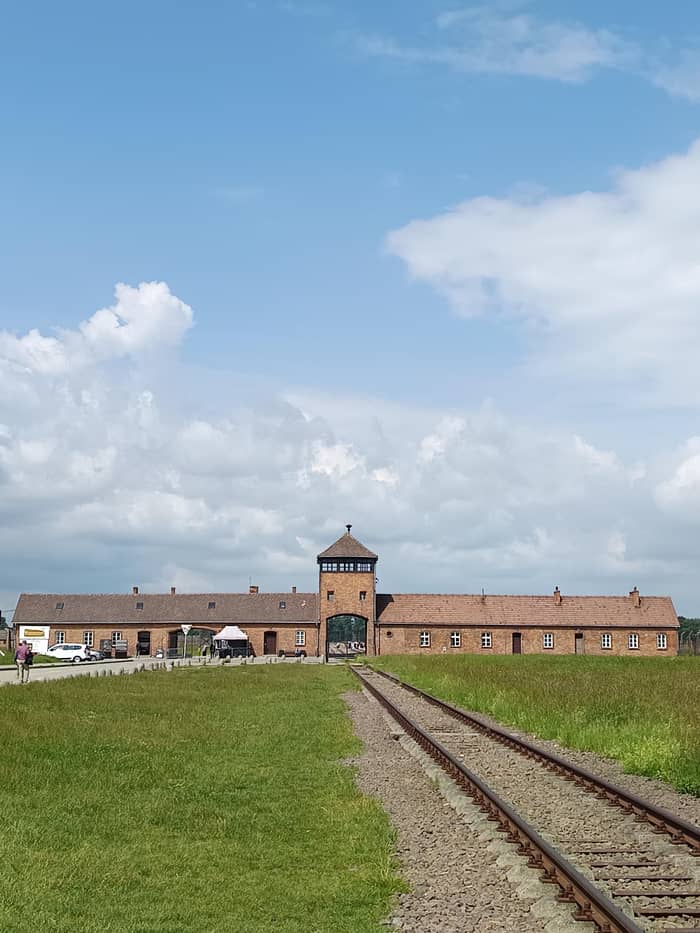
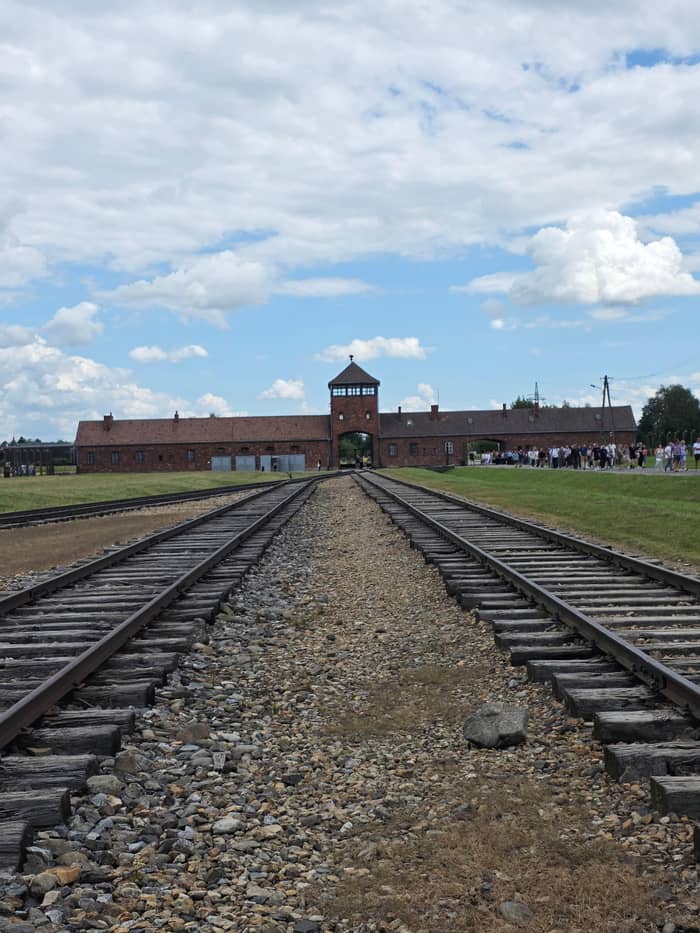
Birkenau is vast, and the view from the gate makes that plain at once. Building work started in October 1941, and from March 1942 the camp operated as a branch of Auschwitz.10 The Memorial calls it the largest concentration camp: nearly 300 primitive barracks, mostly of wood, spread over nearly 200 hectares.24,61 Here, the Memorial writes, stood most of the installations of mass murder, where approximately 1 million European Jews were killed.62
The way in is from ul. Ofiar Faszyzmu 12, under the gate tower that the Memorial calls the Death Gate.46,47 The guided route follows the ramp where deportees were unloaded, enters the barracks and reaches the ruins of gas chamber and crematorium II or III.3 In January 1945 the SS blew up crematoria II and III on January 20 and crematorium V on January 26.63 The ruins have been left as they were.
Between the ruins stands the International Monument to the Victims, unveiled in 1967 to commemorate the murdered people.48 It is the place at Birkenau where candles may be lit.4 Human ashes lie in parts of the grounds.61 The surfaces are uneven because of their historic character, and in winter the regulations ask visitors to use only the designated paths.25,64 Dress for the weather: much of the Birkenau visit is spent outside.
Tours of both camps
Compare days that include Auschwitz I and Birkenau.
Compare all 3 options
Compare days that include Auschwitz I and Birkenau.
≈
View≈
View≈
ViewCurrency conversion uses the ECB reference rate on GetYourGuide from-prices. The exact price is displayed when you book.
History
1940
728 Polish political prisoners arrive on June 14, 1940.9
1941
Construction starts in October 1941.10
1942
Birkenau opens in March 1942; about 197,000 Jews are deported that year.10,11
1944
Over 600,000 Jews are deported to Auschwitz.12
1945
Soviet soldiers open the gates on January 27, 1945.13
1947
Survivors initiate a museum on the camp grounds.14
The Memorial estimates the total number of victims of Auschwitz at some 1.1 million people.5 About 400,000 people were registered in the camp during its almost 5 years of operation, and the Memorial estimates some 900,000 further victims, mostly Jewish children and elderly people, who were murdered in the gas chambers immediately after selections and never entered in the camp records.65,5 Probably about 90% of all the victims of Auschwitz died at Birkenau.66
The deportation of Jews to Auschwitz rose year by year. The Memorial counts about 197,000 Jewish deportees for 1942; the figure for 1943 is about 270,000, and for 1944 it is over 600,000.11,23,12 Over the years of the camp, the total came to almost 1.1 million.12 More than 9 out of every 10 people who died in Birkenau were Jews.66 Behind each of these figures stand individual lives, and the exhibitions at Auschwitz I return again and again to names, faces and family photographs rather than totals. Your educator will do the same.
Other groups were persecuted and murdered here too. A large proportion of the more than 70,000 Poles who died in the Auschwitz complex perished in Birkenau, as did approximately 20,000 Roma and Sinti, along with Soviet prisoners of war and prisoners of other nationalities.67,68 The figures in this section come from the Memorial's own history pages. They are best read before the visit, so that the places you see carry their weight.
Video
DW Travel on YouTube · The clip loads only after you tap play.
was the only concentration camp that functioned simultaneously as a centre for systematic extermination in gas chambers
With respect
The camp was liberated on January 27, 1945, by Soviet soldiers of the First Ukrainian Front's 60th Army.13 About 7,000 prisoners were still awaiting liberation in the main camp, Birkenau and Monowitz.69 The Memorial's history pages describe the first help given to the survivors and the commissions that began to document the crimes. Days earlier the SS had blown up the crematoria at Birkenau.63
In 1947, on the initiative of some of its Survivors, the State Museum was founded on the former camp grounds.14 It exists to protect what survives of the camp, to remember the victims, and to research and teach.70 The city of Oswiecim dates the Museum's establishment to 2 July 1947.71 Everything you see on the visit is preserved under that mission, and visitors are expected to conduct themselves accordingly.33
Poland proposed the site, and UNESCO listed it in 1979, on condition that it stand alone as the single camp on the list and as a symbol for comparable places.72 Since 2007 the listing has carried the title Auschwitz-Birkenau, German Nazi Concentration and Extermination Camp.73 The Memorial describes Auschwitz as the only concentration camp that functioned at the same time as a center for systematic extermination in gas chambers.29
Inside the Memorial, every guided group follows the same core route, and only licensed educators may guide.8 What differs between tours from Krakow is the transport, the time of day and the time allowed at each site. When you compare an Auschwitz Birkenau guided tour from Krakow, look at the itinerary: the guided day this site sells gives Birkenau 1 hour after 2 hours in the main camp, while the official tour allows Birkenau 1.5 hours.
If you would like more than the general tour, the Memorial also runs a specialist tour that adds selected national exhibitions, the area called Kanada, and what is left of crematoria IV and V with their gas chambers.26 Study tours of around 6 hours go further still.27 Educators work in a long list of languages, among them Hebrew, Hungarian and Norwegian.74 For visitors booking on their own in English, the Memorial runs guided starts from 08.30 through the day.75
Whichever you choose, read the rules before you go. Visits are not recommended for children under 14, entry passes are personal and limited, and the educator's lecture may not be recorded.28,76,77 Audio guides and video guides, including phone apps, are prohibited across the Memorial: the educator is your guide.78 Afterwards you may want time to talk or to sit quietly, and a slow evening in Krakow helps the day settle.
FAQ
The general tour covers the Auschwitz I exhibitions and the original buildings at Birkenau.3
Room No. 5 of Block No. 4 and the cellars of Block No. 11 are off limits to cameras.32
One is in the main camp, the Execution Wall; the other is the International Monument at Birkenau.4
National exhibitions, the Kanada area and the ruins of crematoria IV and V.26
It is the single camp on the list, standing for others like it.72
Sources
Planning the Auschwitz and Wieliczka day? A real person answers here.